
Table of Contents
In recent years, concrete curbs have transformed from a simple technical detail into a significant element of urban design. Accordingly, today their function is no longer just separating the roadway from the sidewalk – modern standards give concrete curbs visual and functional weight. That’s precisely why, on a global scale, architects and landscape designers are actively trying to harmoniously integrate this road element into the overall urban space.
In many cities in Europe and Asia, the design of concrete curbs is being refined over time – their form, color, and processing technology are changing to better adapt to specific districts, traffic intensity, and pedestrian flow.
In addition to visual transformation, concrete curbs are increasingly better responding to specific climatic conditions and local construction standards. It’s also important that modern curb stone design takes into account various user needs – whether it’s traffic management, accessibility, or environmental requirements.
In some countries, they are often made from recycled materials – which is in full compliance with so-called “green construction” standards. This trend is particularly relevant in Scandinavian countries and Germany, where a particular curb simultaneously fits both ecological and visual standards.
Concrete Curbs and Urban Aesthetics: Visual Innovations
In some European cities, the standard is not just gray curbs – design increasingly features diversity in color, texture, and form. This partly means that this element has become a means of expressing the city’s identity, which should emphasize the character of a specific district.
For example, in Scandinavian countries, light-colored concrete curbs are often used, which organically connect the sidewalk and road surface and create a minimalist, harmonious visual. Such a solution is particularly effective in cities where architecture and landscape don’t require additional visual load – on the contrary, they need simple forms and correctly chosen tonality.
At the same time, in Southern Europe, we often encounter so-called “curbs” in dark tonality, which creates earth-tone-oriented aesthetics and emphasizes the natural structure of the space.
Concrete Curbs as One of the Guarantors of Safety
In modern cities, concrete curbs play an important role in ensuring universal accessibility of space. In many countries, low or sloped curbs are already considered standard, which are convenient for wheelchair users, as well as parents with children and elderly people.
Today in the world, curb geometry is becoming increasingly diverse – rounded corners, sloped edges, or completely minimalist, straight-line forms create different visual and functional experiences. The selection of a specific form directly depends on the street’s purpose – whether it’s a transport highway, residential quarter, or commercial zone.
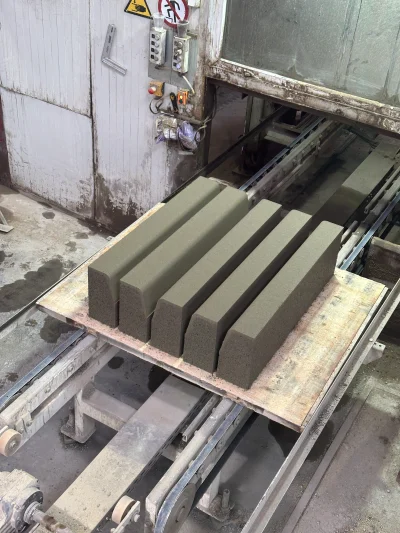
Curbs in Different Types of Spaces: Practical Examples
In urban planning, concrete curbs are no longer used only for paving sidewalks and roads. They have become equally important in parks, recreational zones, commercial districts, and residential complexes, where each space has specific requirements from both functional and visual perspectives.
For example, in recreational spaces – parks and green areas – curbs are often used to separate green and rest zones. A curb stone of the right form and height helps prevent soil erosion and simultaneously creates a clear visual boundary between paths and grass-covered territory.
In commercial and public zones, this road element also performs an additional function – it not only visually separates the sidewalk but also manages traffic flow and is often integrated with drainage or lighting systems. In front of shops, cafes, or administrative buildings, we often encounter low, refined-design curbs that are in full compliance with the city’s image and style.
As for residential areas, there the “curb” helps separate yards, paths, and walkable sections. In such an environment, special attention is paid to safety and durability – it must withstand both pedestrian movement and heavy vehicle traffic. At the same time, from a design perspective, neutral tonalities are in demand that blend well with the style of buildings and yard paving.
The Importance of Local Production
In the case of concrete curbs, local production is not just a matter of logistical comfort or price – it directly determines product quality, compliance with standards, and the conditions necessary for timely project implementation. It’s not surprising that local manufacturers better understand the region’s climatic, urban, and construction specifics, which is particularly important when curbs are integrated into the city’s functional infrastructure.
Moreover, one of the important advantages of local production is that a company can quickly deliver products of various sizes and forms to the client according to specific project specifications. This not only accelerates the construction process but also helps maintain high quality – each product regularly goes through quality control stages directly at the factory. At the same time, unlike imported materials, local production is less dependent on logistical delays.
Today, when urban standards are changing rapidly and projects require more flexibility and a quality-oriented approach, a local manufacturer like “Legi” becomes even more particularly significant. Our experience and technical base allows curbs to be not just a construction element but a full-fledged part of urban design.
A Detail That Simultaneously Divides and Unites Space
In the design of modern cities, curbs have already become a universal component that ensures safety, visual identity, and sustainability, responds to the requirements of specific spaces, and actively fits the surrounding architecture and landscape.
In this process, an innovative approach plays a decisive role – diversity of forms and colors, modern technological production, and adherence to high standards. In urban space, where every detail matters, the curb is a solid foundation for the city’s structural and visual integrity.
That’s precisely why the technical resources and knowledge of local manufacturers like “Legi” create an important foundation for further development of modern standards. This experience allows curbs to be maximally well-adapted to the needs of specific urban spaces – functionally, visually, and structurally.