
Table of Contents
Modern cities are abundantly saturated with visual information, where the most important role is played by details necessary for indicating direction and aesthetic expression – among them, one of the most significant is the curb (so-called “bordiuli”; “bardiuli”), which creates a kind of boundary between the road and sidewalk and helps us better perceive space.
It’s not surprising that the rapid development of digital technologies and the creation of innovative materials are causing revolutionary changes in the city’s visual landscape. Design trends, interactive systems, and eco-friendly technologies are forming new standards whose influence broadly extends to the process of urban planning and forming the city’s identity.
In this context, the image of the future city requires a new understanding of curbs – as a functional and technologically active detail that responds to environmental changes in real time while simultaneously maintaining aesthetic value.
Therefore, in this blog we’ll talk about innovations that are already taking root in urban design in various countries around the world and we’ll examine ways in which decorative curbs can become a new type of spatial communication tool in future cities.
Why Curbs Are No Longer Just Road Dividing Elements
For years, the so-called “bordiuli” was only a technical strip separating the road and sidewalk – with several basic functions – to separate spaces and regulate the directions of transport and pedestrian movement; however, in contemporary urban planning, including in Georgia, today this road element is gradually taking on other weight as well.
When arranging new squares, parks, residential areas, or municipal streets, increasingly more attention is paid to the visual side. Through the use of different colors, textures, or forms, curbs often emphasize the concept of a specific zone and create visual logic that makes the space more organized and complete.
In addition to aesthetics, curbs, over time, also acquire additional functions: they are often used in residential zones to slow vehicle traffic, also define the boundaries of pedestrian and recreational spaces, and in some cases help form green lawns. All of this indicates that curbs today are already a much more important element of city planning than simply a road dividing strip.
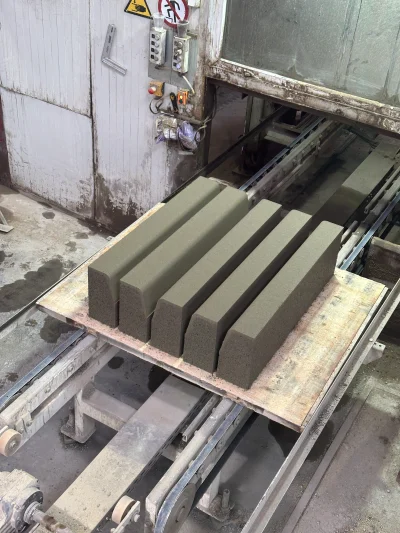
Decorative Curbs as a Defining Feature of Space Identity
As they say, a city’s identity is created by everyday details that create a special mood among locals and visitors – and decorative curbs are one of the most neutral but effective instruments in this process. They often remain unnoticed; however, it’s precisely their visual signals that enrich a specific area with unique rhythm and character.
Specialists involved in urban space planning almost always try to give specific territories distinctive identity through decorative elements – whether it’s a street adjacent to a park, a new boulevard, or a historical quarter. The so-called “bordiuli” in such a context becomes not only an indicator of a functional boundary but also an emotional and symbolic detail: it can be associated with tranquility, modernity, eco-friendly environment, or traditional style.
This is how a kind of visual code is formed that creates the unique face of space – a face that visitors remember, while locals perceive as an inseparable part of their environment.
Curbs and Inclusive Design
The idea of inclusive design in urban space is not limited only to physical accessibility – it aims to create an environment where all users move in equal conditions, whether they’re a person with disabilities, elderly, or a parent with a baby stroller. Taking this context into account, curbs are even more than just a visual boundary; they transform into an important component that, along with safety in everyday life, also ensures comfort.
An inclusively planned curb, with its sloped corners, significantly simplifies orientation in space. Correctly selected material and structure make it possible for the street to be functional for everyone – as a result, curbs gradually acquire new social weight and contribute to the equal distribution of city spaces.
This approach echoes the idea that urban design cannot be limited only to aesthetics – its main purpose is to form an environment that gives everyone the opportunity to move freely, feel comfortable, and fully participate in city life.
Technological Integration: How Curbs Can Become One Component of Smart Cities
After inclusive design, the question naturally arises: what happens when technology is added to aesthetics and accessibility? This is precisely where the concept of so-called smart cities intersects, where every detail of urban space serves data collection and management. In this transformation, curbs can become not only a visual boundary but an intelligent system that will be integrated into the city’s digital network and will invisibly control everyday functioning.
Imagine a curb equipped with sensors that collects data in real time on pedestrian and vehicle flow, atmospheric humidity and temperature, or lighting needs in a specific zone. This information integrates directly into the city’s analytical system, which allows management to quickly and efficiently manage movement, lighting, etc. Most importantly, all of this happens unnoticeably, through the medium of a critically important element – the curb.
Such integration is particularly important in urban development, where the priority is efficient space management and saving reserve resources. Future decorative curbs may be closely integrated with systems such as street lighting, noise control, or electric vehicle charging points. Thus, this element can freely become not only part of the visual structure but an active participant in the so-called smart city ecosystem.
Innovation or Hypothesis: How Realistic Is the Idea of Smart Curbs?
The concept of smart curbs today may be perceived by many as an unrealistic idea; however, in reality it’s already taking root in global urban practice. In Europe’s leading cities, the integration of infrastructure elements with sensors, data analytics, and energy-efficient technologies is actively being tested. This means that technological prerequisites already exist – what remains is their large-scale implementation and cost optimization.
What is the main challenge? First of all, financial investment and the difficulty of infrastructure renewal, especially in countries where urban space is still in the standardization process. However, global trends make it clear that the future belongs to data-based urban management systems – and in this process, curbs can freely become one of the main components.
Therefore, the main question is not “is it possible?” but “when and on what scale will this integration occur?”